


In April 2026, The Goldman Sachs Group (GS) is navigating a high-stakes Strategic Renaissance. After officially exiting its embattled consumer lending platform in 2025, the firm has returned to its core identity: a high-margin powerhouse of M&A advisory, trading, and asset management. While the stock has surged 89% over the past year to trade near $863, investors are divided. Bulls point to the March 2026 Basel III revisions, which lowered capital requirements, as a catalyst for a massive buyback cycle, while skeptics highlight a Hold consensus from 14 analysts and a year-to-date decline of 5.6%.
Despite the recent cooling of the AI-driven market, Goldman’s fundamental fee-machine is accelerating. With a net margin of 32.59% that leads the peer group and a dominant role in the 2026 M&A revival, the firm is positioning itself as a proxy for global capital markets recovery. This guide breaks down the GS stock price prediction for 2026 using data from Zacks Research, Wells Fargo, Morgan Stanley, and Evercore.
You will also discover how to gain exposure to Goldman Sachs (GS) stock futures through BingX TradFi.
Top 5 Things for Goldman Sachs Investors to Know in 2026
- The $57.70 EPS Target: Consensus estimates for fiscal 2026 have jumped 12.4%, driven by a 15% projected surge in global M&A volume and stabilized interest rates.
- Regulatory Relief: The March 19, 2026, Basel III proposal decreased capital requirements for Category I banks by 2.4%, unlocking billions in deployable capital for GS.
- The Insider Signal: High-level executives, including the CFO and EVP, have sold over $112 million in stock over the last three months, raising concerns about local valuation peaks.
- Dividend Growth: GS recently boosted its quarterly dividend to $4.50 with a 2.1% yield, supported by a conservative 31-35% payout ratio and a 22% five-year average annual increase.
- Private Credit Resilience: Unlike industry peers facing a redemption surge, Goldman’s private credit fund saw withdrawal requests under 5% in Q1 2026, signaling superior liquidity management.
What Is Goldman Sachs (GS)?
The Goldman Sachs Group, Inc. is a leading global financial institution that provides a wide range of financial services to a substantial and diversified client base. Following its 2025 pivot away from Main Street consumer banking (Marcus), the firm is now a streamlined Wall Street pure-play.
Its competitive advantage lies in its #1 global ranking in completed M&A and equity underwriting. The firm operates through three primary segments: Global Banking & Markets, Asset & Wealth Management, and Platform Solutions. Under CEO David Solomon, the firm's Strategic Renaissance focuses on high-ROE activities, leveraging a fortress balance sheet with $254 billion in market capitalization to capture fee-rich institutional mandates.
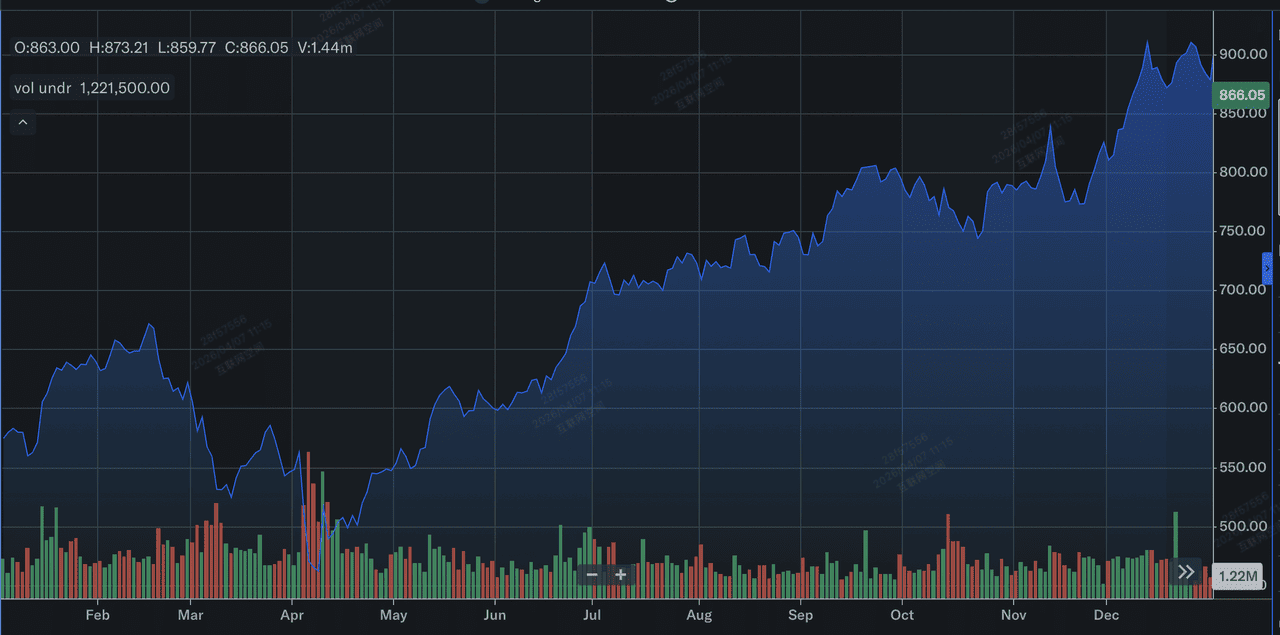
Goldman Sachs' stock performance in 2025 | Source: Yahoo Finance
Goldman’s Strategic Pivot: Back to the Core
- The Consumer Exit (2025): By shedding low-margin credit card and point-of-sale lending, GS improved its ROE profile and reduced its exposure to domestic retail credit risks.
- The M&A Super-Cycle (2026): Stabilizing 10-year Treasury yields at 3.5-4.5% have unleashed a massive backlog of healthcare and energy sector deals, where Goldman traditionally captures the largest fee share.
- The ETF Expansion: The 2026 acquisition of Innovator added $31 billion in defined-outcome ETF assets, diversifying recurring fee revenue in the Wealth Management segment.
Goldman Sachs (GS) Financial Health: Record Forecasts for 2026
Goldman Sachs is entering mid-2026 with robust momentum, highlighted by a record annualized EPS forecast of $57.70–$57.86, a 12.7% year-over-year increase. The firm’s operational efficiency is evidenced by a peer-leading 32.59% net margin, while its income profile remains attractive with a 2.1% dividend yield at $18.00 annualized.
However, investors are weighing these fundamentals against a 16.8x P/E ratio, which represents a premium relative to its five-year average. All eyes are now on the April 13, 2026, earnings report, where the bank is expected to post $16.65 billion in revenue, potentially validating its current valuation stretch.
Goldman Sachs (GS) 2026 Investment Outlook: Alpha vs. Insider Selling
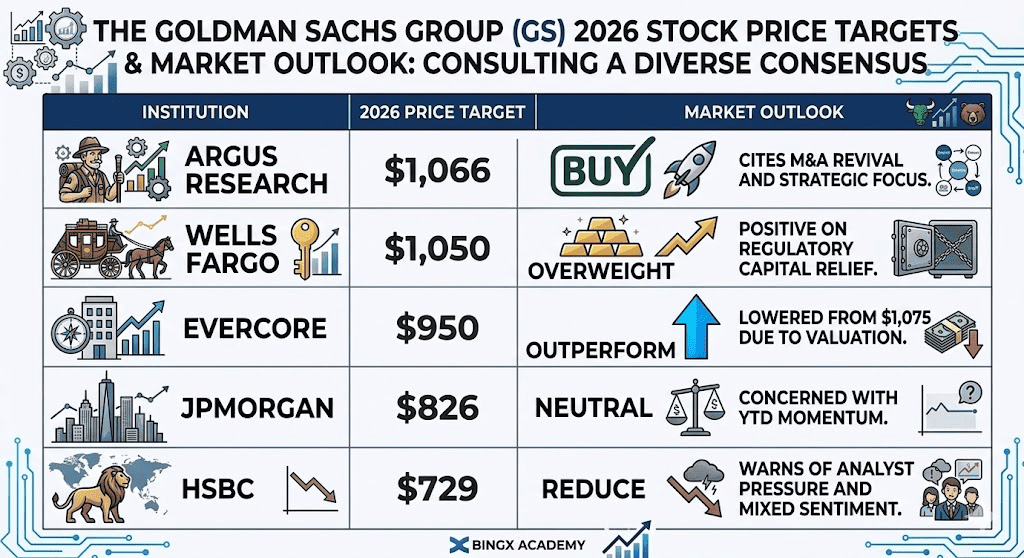
Goldman Sachs' stock forecast for 2026 by Wall Street analysts
The 2026 landscape for GS is a tug-of-war between record-breaking earnings efficiency and the smart money exits observed in early Q1.
The Bull Case: Goldman Sachs' $1,050 Blue-Chip Breakout
The bull narrative hinges on a regulatory unlock following the March 19 Basel III revisions, which decreased aggregate capital requirements for Category I banks by 2.4%. This shift effectively releases billions in idle capital, allowing Goldman to pivot from defensive liquidity to aggressive shareholder returns. Investors should monitor for an upsized share buyback announcement during the April 13 earnings call; a significant increase could retire 5–6% of the float, creating a powerful EPS pop that forces a market re-rating toward the $1,050–$1,066 targets set by Wells Fargo and Argus.
Practically, this scenario requires Goldman to capture the lion's share of the projected 15% M&A volume surge in 2026. High-profile mandates, such as the SpaceX IPO underwriting and Golar LNG strategic advisory, serve as high-margin fee catalysts. If the firm hits its 17.6% ROE forecast by mid-year, it validates the Strategic Renaissance, proving that the exit from consumer banking has successfully transformed GS into a leaner, high-yield pure-play on global capital markets.
The Base Case: GS Stock's $930 Fair Value Consolidation
In the base case, Goldman functions as a high-quality compounder rather than an explosive growth engine. The stock is expected to track the broader S&P 500's 12% total return forecast, supported by a robust 32.59% net margin that remains the envy of the sector. Valuation-wise, the Simply Wall St Excess Returns model places intrinsic value at $926.90, suggesting that while the easy gains from the 89% one-year surge are over, the stock is still modestly undervalued by roughly 7%.
For investors, this scenario is defined by yield and stability. The current 2.1% dividend yield is secured by a conservative 31–35% payout ratio, providing a reliable income floor even if price action remains sideways. While 14 analysts maintain a Hold rating due to the stock’s current premium P/E, steady trading revenues and the $31 billion Innovator ETF acquisition provide enough diversified fee income to settle the price near the $930 consensus target by year-end.
The Bear Case: Goldman Sachs Stock at $730 Amid Recession Guard Pullback
The bear case is triggered by external macro shocks, specifically a spike in oil prices to the $105–$115 range, which Goldman’s own research suggests would lift US recession odds to 30%. In this risk-off environment, the fee-rich M&A pipeline would likely freeze, and the $112 million in recent insider selling by the CFO and EVP would be viewed in retrospect as a definitive local top. Negative pressure from HSBC and Morgan Stanley could drive the stock to test its $850 200-day moving average before sliding toward the $729–$730 level.
A secondary threat lies in the $2 trillion private credit market. If AI-driven earnings erosion affects software borrowers, a key sector for private lenders, Goldman’s Asset Management segment could face significant valuation write-downs or a spike in redemption requests. Investors should watch for Forensic Red Flags, such as inventory growth decoupling from realized cash flow; if Q1 earnings miss the $15.92 EPS estimate due to margin compression, the 'priced for perfection' valuation will likely evaporate, leading to a sharp institutional exit.
GS Stock Price Forecasts for 2026 By Wall Street Analysts
|
Institution |
2026 Price Target |
Market Outlook |
|
Argus Research |
$1,066 |
Buy: Cites M&A revival and strategic focus. |
|
Wells Fargo |
$1,050 |
Overweight: Positive on regulatory capital relief. |
|
Evercore |
$950 |
Outperform: Lowered from $1,075 due to valuation. |
|
JPMorgan |
$826 |
Neutral: Concerned with YTD momentum. |
|
HSBC |
$729 |
Reduce: Warns of analyst pressure and mixed sentiment. |
How to Trade Goldman Sachs (GS) Stock on BingX
Maximize your trading potential by using BingX AI tools to navigate Goldman’s earnings volatility.
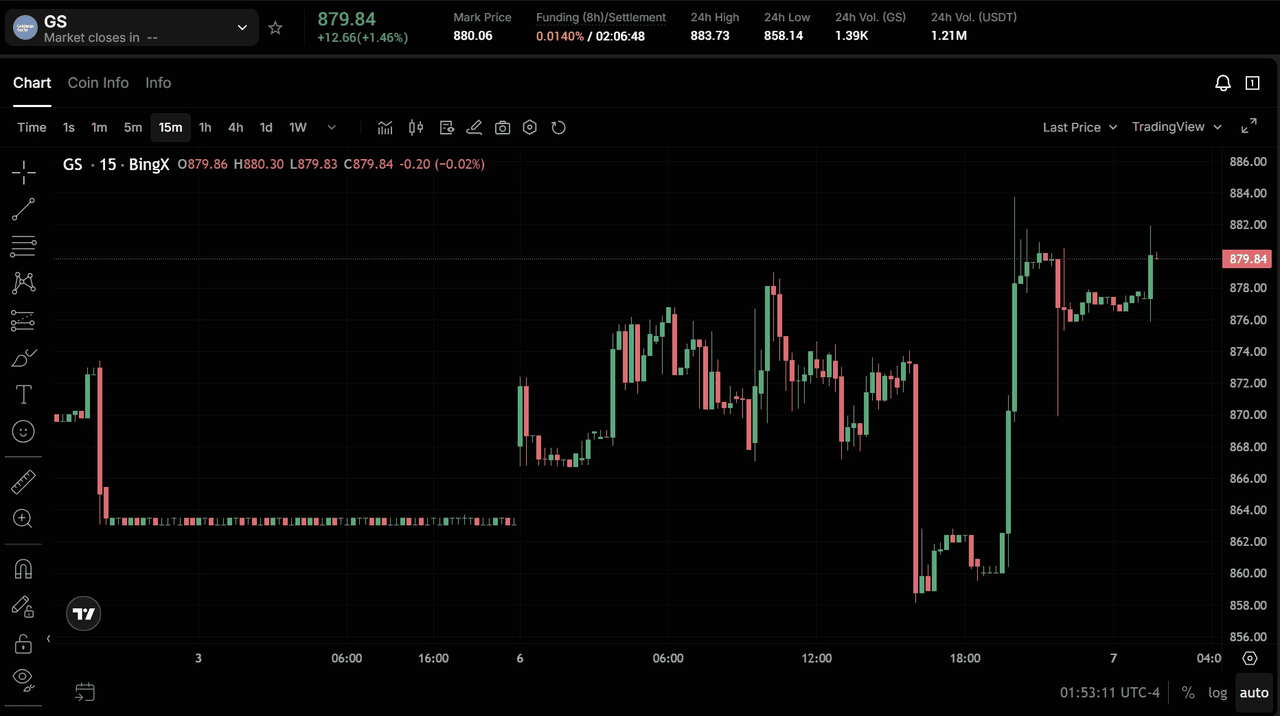
GS/USDT perpetuals on the BingX futures market
Long or Short Goldman Sachs Stock Futures on BingX TradFi
- Navigate to BingX TradFi and select Stock Futures.
- Select the GS/USDT perpetual contract.
- Set your leverage (e.g., 2x–5x) and select Open Long if you expect an earnings beat or Open Short to hedge against insider selling risks.
- Set Take-Profit (TP) and Stop-Loss (SL) levels before the April 13 earnings release.
Top 5 Risks to Watch for Goldman Sachs Investors in 2026
To navigate the 2026 market, investors must balance Goldman’s Strategic Renaissance against these five critical macro and operational headwinds.
- The Insider Liquidation Signal: With key executives, including the CFO and EVP, divesting over $112 million in stock during Q1, and insider ownership sitting at a mere 0.55%, retail investors should monitor for a valuation ceiling where leadership sentiment diverges from the current 89% one-year rally.
- Oil-Induced M&A Freezes: Goldman’s GIR research indicates that if oil prices sustain a climb toward $115 per barrel, U.S. recession odds spike to 30%; such a macro shock would likely paralyze the corporate deal-making and IPO pipeline that fuels Goldman’s core fee income.
- Basel III Implementation Creep: While the March 2026 proposal to cut capital requirements by 2.4% is a massive tailwind, any regulatory backtracking or "gold-plating" during the finalization phase would directly cap the firm’s ability to execute its multi-billion dollar share buyback program.
- Private Credit and AI Disruption: As a major player in the $2 trillion private credit space, Goldman faces systemic risk if AI-driven earnings erosion affects the software sector's ability to service debt; watch for a spike in Q2 redemption requests as a lead indicator of asset management margin pressure.
- Geopolitical Operational Friction: From thwarted attacks on Paris offices to shifting trade policies, rising geopolitical tensions introduce hidden costs, higher insurance premiums, enhanced security mandates, and trading desk volatility that can erode the firm's currently pristine 32.59% net margin.
Final Thoughts: Should You Invest in Goldman Sachs (GS) in 2026?
Goldman Sachs in 2026 is a story of operational excellence vs. valuation gravity. At a P/E of nearly 17x, the stock is no longer a deep value play; it is a premium bet on the health of global capital markets. For investors, the April 13, 2026, earnings call is the critical litmus test.
The $57.70 EPS forecast provides a strong bullish floor, but the aggressive insider selling suggests institutional caution. If you believe in the M&A Super-Cycle, GS remains the gold standard for financial exposure. However, conservative traders might wait for a pullback toward the $835–$845 range before initiating a long-term position.
Risk Reminder: Trading and investing in equities like GS involves a high risk of capital loss. Goldman’s heavy reliance on market volatility and regulatory shifts introduces significant price swings. Conduct independent research before allocating capital.
Related Reading
- GE Aerospace (GE) Price Prediction 2026: Can the $190B Backlog Defy Valuation Fears?
- Ferrari N.V. (RACE) Stock Outlook for 2026: Can An Iconic Brand and EVs Drive RACE Stock to $550+?
- Mastercard (MA) Stock Price Forecast for 2026: Fintech Giant or Regulatory Target?
- Circle (CRCL) Stock Outlook for 2026: Can USDC Growth and Dominance Drive CRCL Stock to $250+?